�Q!>8�E4Z
摘要: k�KVq,41'
U[~BW�[[@f
RPC Photonics公司有高品质的的工程漫射体BSDF测试数据,但它对于FRED帮助甚少,下面这个步骤描述了如何利用FRED脚本转换RPC Photonics提供的TXT文件,并将数据直接应用到FRED的Tabulated scatter 散射模型。 di�6A.�N5A
�n?@o:c5,r
背景: ���<_""�4�
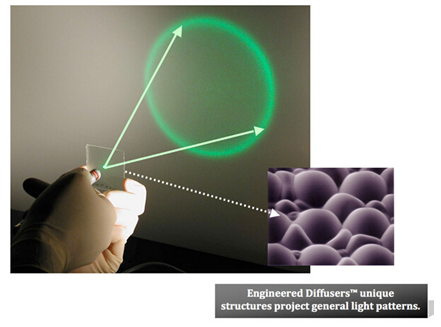
Thorlabs和RPC Photonics联手共同推出的新型漫射体及光束整形技术,可以解决其他技术的不足,大大改善了诸如光刻系统、有效固态照明,显示,背光,显示亮度增强和投影屏等大多数应用的性能。这项我们称之为工程漫射体(Engineered DiffusersTM)的新概念,与其他技术有许多不同。与诸如磨砂玻璃、乳色玻璃和全息元件等随机漫射体截然不同,工程漫射体要求对于每个散射中心,通常为微透镜单元,都进行控制。例如全息漫射体可以视为一组随机排列的透镜,但是通过全息曝光形成的类透镜效果只能通过静态方式进行控制:而无法单独操控每个微透镜单元,这也帮助解释了全息漫射体无法控制光的分布和轮廓。另一方面,在工程漫射体中,每个微透镜单元形成漫射体,由其凹形纵断面和在阵列中的位置所确定。同时,为了确保漫射体不受输入光束变化的影响,并且不产生衍射效果,微透镜单元的分布是随机的,根据产生相应的光束形状函数所选取的概率分布函数来确定。因此,工程漫射体同时保留了随机与确定性漫射体的优点,从而实现高性能的光束整形功能。 �y�S/�ovd�
FRED是美国Photon Engineering 公司开发的光学工程仿真软件,其在杂散光分析中独特的算法、高效的准确性,使其与其它同类产品相比更具优势。本案例我们重点讲述如何由RPC Photonics的BSDF数据转为FRED可识别的散射数据。图1. RPC Photonics工程漫射体结构及光束投射形状 IsO'aFK)ln
)_EQU8D4ug
�NXD�V3MH=
v
�F L{�j�
步骤 w&�;�\�}IS
=Fea�v��yx
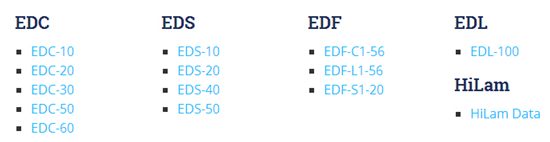
1、 在http://www.rpcphotonics.com/bsdf-data-optical-diffusers/下载并解压BSDF数据到某一文件夹下,选择“Raw data”文件。 Jg|3Wjq��5
图2. RPC Photonics工程漫射体不同类型的散射数据 nZQZ�!Vfj�
D00rO4~6D%
2、 将 http://fred-kb.photonengr.com/wp-content/uploads/sites/2/2015/06/constructRpcScatterFile.frs脚本文件放在步骤1中的文件下。(脚本代码放在了本文的最后) o
<LA2�q`T
3、 打开FRED并运行脚本文件,会输出如下“<SAMPLE>_FRED.txt”格式,<SAMPLE>即为RPC Photonics散射片数据集 (����JFa�
例如下所示: ������]\P�
Sample name: EDF-C1-56 Z.m.Uyz{7
Merging data from file EDF-C1-56 0-0.txt rjU $*+��
Finished merging RPC data for sample EDF-C1-56 'r���f='�Y
FRED formatted data file: D:\FRED\散射片数据\EDF-C1-56_FRED.txt -'k<�2�"z
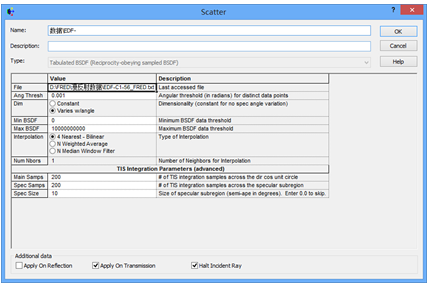
4、 生成了FRED可识别的文件后,将散射模型导入到FRED里面 =}7�w�pTc,
a. 创建一个新的散射库 ik�~hL/JD\
b. 散射模型命名 �X�uHJ�y
c. 改变散射模型为“Tabulated BSDF”. #�.}S�u+XF
d. 在File框出右键选择“Replace With Data From a File”, 选择步骤三生成的数据文件(如EDF-C1-56_FRED.txt ) �l;Z�c[6�
e. 切换为“Varies w/angle” 选项(假定所有的RPC Photonics datasets 数据有多个测试角度。 ��~�;m~�)D
f. 在底部的对话框中,选择透射散射、反射停并且你需要终止入射光线, 4E3HY����Z
g. 点击OK :�K�X/GN!n
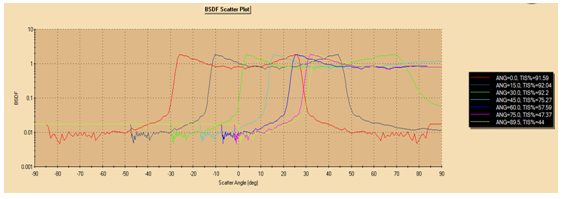
5、 数据输入后,可点击“Plot”按钮验证BSDF模型及总的散射值 :� �M0LAN
)2�F:l0�g�
(B]Vw�+��/
脚本代码: �)�'%L#��
R�e<X~j5�]
'#Language "WWB-COM" *Gu��Cv�3|
�?�vf{���v
Option Explicit ��r~nrP=-%
�iCk3�4C�7
Sub Main 1a��YO:ZPy
;?i��nf`t�
'Cleanup ��1S�z5&jz
ClearOutputWindow() N!Rync�J��
�BY,%+>bc)
Print "Merging RPC Photonics BSDF Data Files" k1-?2k�f"{
SetTextColor(255,0,0) 2%v�w�C]A�
Print "Note: Script should be located in the same folder as the BSDF TXT files." 9FV#@uA}D�
Print "Note: Do not run this script multiple times without deleting the output file between executions." w�/G5I )G�
SetTextColor(0,0,0) �aD�za"Ln
e%'9oAz�
'Current directory of this script (should be the same as the text files being merged) Bb:jy�!jq_
Dim cDir As String �u#���=N8�
cDir = MacroDir$ & "\" �Kt}dTpVFr
�>)N,V��;j
'Array which will be populated with the list of files to be merged J+Du�Q�;k;
Dim fList() As String, curFile As String �z��Cv�R/�
GetFileList( cDir, fList ) m}T�u^d�y�
D zD�t:.JZ
Print "" 3)0�*hq&83
Print "Files found for merging:" �6�xz&Qi7w
For Each curFile In fList l�`$f@'�k�
Print Chr(9) & curFile Pn7oQ��A\
Next �Mz��K&Jh
kV6>O �C&^
'Split the first text file name found to get the sample name. First file should be 0-0 measurement. C����?x��
Dim nameArray() As String, sampName As String %t�+��V�8A
nameArray = Split(fList(0)," 0-0.txt") �:sT<<LtI-
sampName = nameArray(0) �=t)e�T0��
Print "" �r="X\ [on
Print "Sample name: " & Chr(9) & sampName �AS;{O>}54
6�2vz� 'b
'Open an output file and write the FRED header data k_}ICKz�w1
Dim outFile As String SKRD{MRsux
outFile = cDir & sampName & "_FRED.txt" �@Gn9�x(?J
Open outFile For Output As #1 }��
�A#��C
Print #1, "type bsdf_data" ��{8I�9�3]
Print #1, "format angles=deg bsdf=value scale=1" G2L7_�?/�m
/.WD�'�*H�
'Loop the file list, skip the two header lines and write the remaining data to file k�f5921�(P
Dim lineArray() As String, curLine As Long TS3� 00��F
For Each curFile In fList <j,7Z>Rk\x
Print "Merging data from file " & curFile ���:l9�C7o
ReadFile( cDir & curFile, lineArray ) \�D}/tz5~B
For curLine = 2 To UBound(lineArray) de ](l687I
Print #1, lineArray(curLine) �RI�*�Q-n{
Next t��O~�H�/0
Next 7%w4?Nv3I�
Hh�!x&;�x}
'Close the output file GB[W'QG�iq
Close #1 K{|;'�N-�1
G�0*$&G0nb
Print "Finished merging RPC data for sample " & sampName >)�S�
a#w;
Print "FRED formatted data file: " & Chr(9) & outFile D]oS� R7�h
End Sub �Y}f%/vus
]m}�>/2oSs
'Utility function to read the contents of a file into an array of strings. +U6!
�bu>C
Function ReadFile(ByVal fileName As String, _ ]��i$�CE|~
ByRef lineArray() As String) As Long q(uu��;l[
HVu_@[SYR3
ReadFile = -1 t5��e(9Yhj
Dim oFSO As Object 2,_BO6
!d
Set oFSO = CreateObject("Scripting.FileSystemObject") �+�;>>c�`{
Erase lineArray [;.zl1S�<�
ruE.0VI@
Dim fid As Long �DDkO�g�]�
If oFSO.fileexists( fileName ) Then :�wn |